Long Live the Library Revolution

July 2013, TimeOut Istanbul

gezi library

Lacking in public libraries, Istanbul protesters created a free one in Gezi Park

The Anatolian tradition of imece usulü – people working together for the collective good – pervaded the Gezi Park protests that have rocked Turkey this summer.

From the ban on selling food within the confines of the occupied park (where meals and snacks were distributed for free) to the volunteers who hovered around the Taksim Square area spraying liquid relief into the eyes of tear-gas victims, the protesters grew more defiantly cooperative with every effort made to disperse them.

Exemplifying this spirit, the Gezi Library was one of the first institutions established in the commune-like environment that sprung up in Istanbul’s Gezi Park before it was cleared by police June 15. The library was introduced to the world on June 4, when requests for donations first appeared on social-networking sites. After that, thousands of books began passing through the library’s cinder-block shelves, comprising every genre from novels to textbooks, political magazines to encyclopedias. Similar libraries appeared in Ankara’s Kuğulu Park and İzmir’s Gündoğdu Square, both also hubs for protests.

“Who built the library? You, me, him, her, everybody,” said Ahmet, 38, a Gezi Park occupier who began volunteering at the library when it opened. “There is no system: people freely bring and take books. There is every type of book, because in the park there is every type of person.”
Read the rest of this entry >>

A Masterful Postmodern Novel from Bilge Karasu

June 2013, TimeOut Istanbul

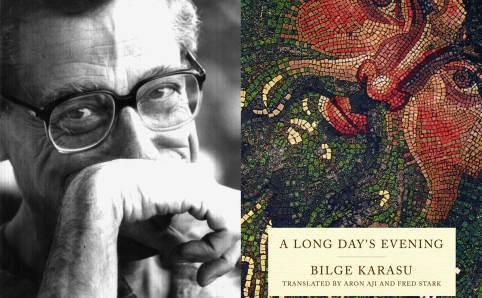
REVIEW: A Long Day’s Evening, by Bilge Karasu, trans. by Aron Aji and Fred Stark

bilge-karasu

An English-language reader might be excused for thinking postmodern literature is uncommon in Turkey. Aside from Orhan Pamuk, few Turkish authors of this genre have been translated or widely publicized.

But the loss is not Turkey’s. Beginning with works such as Ahmet Hamdi Tanpınar’s ‘Saatleri Ayarlama Enstitüsü’ (The Time Regulation Institute) in 1962 and Oğuz Atay’s ‘Tutunamayanlar’ (The Disconnected) in 1972, and continuing with contemporary writers such as Hakan Günday and Doğu Yücel, Turkey has produced many masters of the postmodern novel. Though very different in style and subject matter, their works are characterized by experimental narrative techniques and a dark, insistent questioning of accepted authority.

Bilge Karasu (1930–1995) joined the thin ranks of translated Turkish postmodernist authors in 1994, with the English publication of his novel ‘Night’.Two more of his novels, ‘Death in Troy’ and ‘The Garden of Departed Cats’, were published in English in 2002 and 2004. Known by Turks as a ‘sage of Turkish literature’, Karasu was born in Istanbul to a Jewish father and Greek Orthodox mother. With the recent translation of his ‘Uzun Sürmüş Bir Günün Akşamı’(A Long Day’s Evening), English readers can now enjoy another masterpiece from this inventive postmodernist.

Read the rest of this entry >>

Will Shrinking Rivers Force Kurdistan’s Nomads to Abandon Their Lifestyle?

May 18, 2013, National Geographic Newswatch

Iraqi Kurdistan is home to several groups of nomads, ethnic Kurds and Arabs who migrate between winter villages and summer pastures.

“In winter, we live in houses, but in the summer, in the wild, in tents,” says Ali Tahir Ibrahim, part of a family of Kurdish nomads from the Nerway tribe.

On a recent spring day, he and his brothers were bringing their sheep to drink from the Duhok River in Northwest Kurdistan, just above the Duhok dam.

“We are just passing through here,” he explains. “The sheep can drink it, and even some people drink this water. We live far away from the water; we [usually] transport water by trucks.”

Read the rest of this entry >>

Two Views of the Tigris: A Syrian and an Iraqi Kurd Discuss Turkey’s Dams

May 13, 2013, National Geographic Newswatch

Near the point where Turkey, Iraq, and Syria meet, two villages face each other across the Tigris River.

On one side lies the Iraqi Kurdish village of Faysh Khabur, home to a Chaldean Christian community for more than fourteen centuries. Atop a 7th-century underground church, the community’s “new” church was built in 1861.

On the other bank of the Tigris sits Khanik Village, another ancient Chaldean community — but one that lies in Syria. Syria’s Kurds have maintained a de facto autonomous territory in northeast Syria for the past year, since Assad’s forces abandoned the area last summer.

Read the rest of this entry >>

8,000 Years After its Advent, Agriculture is Withering in Southern Iraq

April 29, 2013, National Geographic Newswatch

As temperatures in Southern Iraq approached 52 degrees Celsius (126°F) last July, Habib Salman, a 52-year-old farmer in the Al-Islah township, shot himself in the head, leaving behind an eleven-member family.

The stream on which their farm relied had recently dried up, jeopardizing his family’s survival. “We lost water, next farming, and next the household supplies, and then it was very hard for us to put food on the table,” says Rakla Abboud, Habib’s wife.

Now, she relies on a few cows and the support of her husband’s brothers to feed herself and her children. Leaving the barren land around her home is not an option, she says.

Read the rest of this entry >>

Enki’s Gift: How Civilization Bubbled From the Waters of Mesopotamia

April 24, 2013, National Geographic Newswatch

“To finish off all living things, that the four-legged creatures of Sakkan should lay no more dung on the ground, that the marshes should be so dry as to be full of cracks and have no new seed, that sickly-headed reeds should grow in the reed-beds, that they should be covered by a stinking morass…”

Those lines are from The Lament for Sumer and Ur, written in the 21st century BC as the Sumerian capital city of Ur was falling to an Elamite invasion from the east. Sumerians had inhabited lower Mesopotamia for more than two millennia at that point. Just a century before, a golden age in Sumerian history — the Third Dynasty of Ur — had begun.

Read the rest of this entry >>


In Cradle of Civilization, Shrinking Rivers Endanger Unique Marsh Arab Culture

April 16, 2013, National Geographic Newswatch

Jassim Al-Asadi knows the Central Marsh of Southern Iraq better than most.

The director of Nature Iraq’s Chibayish branch was born in these vast wetlands at the confluence of the Tigris and Euphrates Rivers, in a traditional Marsh Arab boat.

His birth came two months early in the summer of 1957, surprising his mother, who had been out gathering reeds when her water broke.

“When I opened my eyes, I opened them to see blue sky, the water, the plants, I heard the birds, and I saw the snakes,” recalls Al-Asadi, smiling at the thought. His mother laid him on the reeds she had been collecting, and took him home.

Continue reading “In Cradle of Civilization, Shrinking Rivers Endanger Unique Marsh Arab Culture”

Drought and Dams in Biblical Garden of Eden

April 11, 2013, National Geographic Newswatch

girl-in-pink-dress copy

This spring, National Geographic Young Explorer Julia Harte is traveling along the Tigris River from Southern Iraq to Southeastern Turkey, documenting ancient sites and modern communities along the river before they are transformed by the Ilısu Dam, an 11 billion-cubic-meter hydroelectric dam that will generate 2 percent of Turkey’s power.  

Few places illustrate the vitality of water more starkly than Southern Iraq.

The region that gave rise to human civilization as we know it, the heartland of ancient Mesopotamia, the original referent of the Garden of Eden – Iraq’s lower third has been many things, but today it is the site of a wrenching ecological and human struggle.

Continue reading “Drought and Dams in Biblical Garden of Eden”

And Now For Something Completely Different: A Nuanced Look at Muslim Nationalism in Modern Turkey

February 2013, TimeOut Istanbul

REVIEW: Muslim Nationalism and the New Turks, by Jenny White

jenny-white

Few tropes about Turkey are more tired than the “secularists v. Muslims” refrain.

Affirmed over and over in global media by stock phrases and images — the covered woman with a shockingly bare-headed female friend, “caught between West and East” — the approach reduces the country to two clashing schools of politics and thought through which everything Turkish can be understood.

While it may make Turkey more digestible to foreign audiences, this view sells short the fascinating, untidy patchwork of affiliations and ideologies that comprise the Turkish population today. It elides subtler notions of nationhood that have shaped the law, language, and culture of Turkey, and ignores the many similarities between Muslim and non-Muslim modes of nationalism.

These are the points that Jenny White seeks to illuminate in Muslim Nationalism and the New Turks. To do so, she draws on extensive interviews with Turks from all sectors of society, a vast archive of news and research publications, and her personal experiences in Turkey over the course of more than three decades. Her findings are engagingly presented, never veering toward advocacy, and her claims are supported by a wealth of factual detail and hefty quotes taken from her interviews.

Continue reading “And Now For Something Completely Different: A Nuanced Look at Muslim Nationalism in Modern Turkey”

Turkey: Police ‘anti-terror’ raid snares human rights lawyers

31 Jan., 2013, Global Post

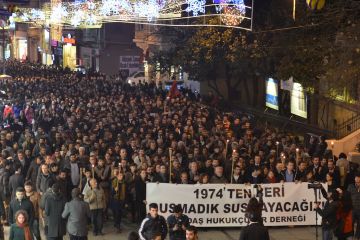
Four nights after the Jan. 18 anti-terror operation in which twelve of Turkey's leading human rights lawyers were arrested, thousands marched down Istanbul's main pedestrian avenue, Istiklal, in protest. (Julia Harte/GlobalPost)
Four nights after the Jan. 18 anti-terror operation in which twelve of Turkey’s leading human rights lawyers were arrested, thousands marched down Istanbul’s main pedestrian avenue, Istiklal, in protest. (Julia Harte/GlobalPost)

It has never been as dangerous to be a human rights lawyer in Turkey as it is now.

So says Güray Dağ, a member of the Progressive Lawyers’ Association (ÇHD): the 2,500 Turkish lawyers who routinely take on the country’s highest-profile cases against police brutality, hate crimes, civil rights violations and baseless arrests.

Twelve of their members, including the head of the association, the head of its Istanbul branch, and several other ÇHD executives, were arrested on Jan. 18 in an anti-terror operation that brought 85 people into custody.

The police detained leftists of all stripes — students, teachers, community activists, musicians, journalists, and lawyers — on charges of belonging to the Revolutionary Peoples’ Liberation Party-Front (DHKP-C), a militant Marxist group aiming to overthrow the Turkish government. Thirty of the detained, including Dağ and two other ÇHD lawyers, were released following interrogations, but the others expect to wait at least six months in custody for their first hearing.

Police and prosecutors have touted the operation as one of Turkey’s strongest blows at the DHKP-C’s secret collaborators yet. But to local critics and international human rights organizations, the case is a new low in the Turkish government’s arbitrary wielding of anti-terror laws against political dissidents.

Read the rest of this entry >>