Our Own Worst Oppressors

February 2012, TimeOut Istanbul (print edition only)

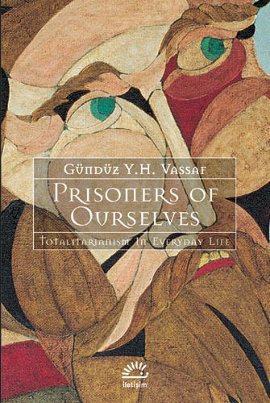
REVIEW: Prisoners of Ourselves: Totalitarianism in Everday Life, by Gündüz Vassaf
Sanity, heroism, menus, agreement, heaven, goals, and words.

These are among the everyday oppressors that Gündüz Vassaf identifies in Prisoners of Ourselves: Totalitarianism in Everday Life. The book, which was written in English in 1987 but only published in English for the first time in December, is a collection of ruminations on the ways that members of liberal, democratic societies exert totalitarian control over themselves and others.

As the above list indicates, Vassaf takes a broad approach to his subject, classifying as “totalitarian” anything that restricts freedom. In particular, Vassaf’s complaint is with trends that provoke people to act against their natures. In these nineteen essays, he argues that humans divorce themselves from life through everything from diurnalism to “death forgetting” — the collective suppression of humankind’s fear of dying.

Continue reading “Our Own Worst Oppressors”

The Sound Of Silence

December 2011, TimeOut Istanbul (print edition only)

REVIEW: The Lost Word, by Oya Baydar (trans. by Stephanie Ateş)

A strange chorus tells the story in Oya Baydar’s latest novel, The Lost Word. The voice of the book veers between third- and first-person, each main character entering the narrative to interject a question, a lament, a memory, before seamlessly weaving back into the scenery once more.

It’s a bit unsettling at first. But this method of storytelling is wholly appropriate for a novel preoccupied with perceptions of otherness — particularly the ineffability of others’ pain — and the gulfs of understanding that have bred so much senseless violence across Turkey in recent decades.

Continue reading “The Sound Of Silence”

Turkey Quietly Moves to Grab a Place in the Global Carbon Trade

28 Nov., 2011, Reuters / Inside Climate News

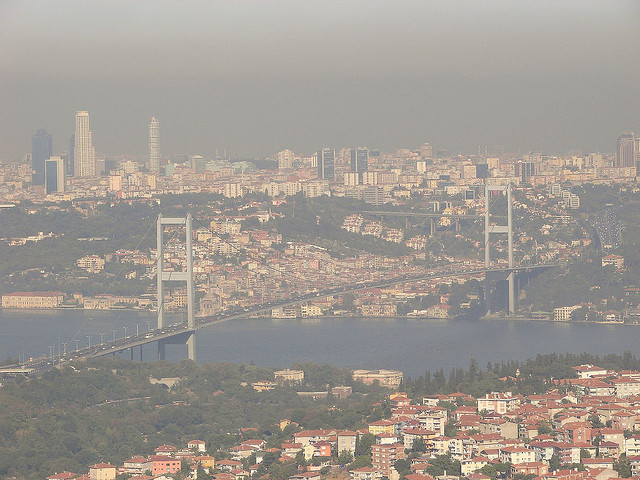
Turkey is laying the groundwork for a mandatory carbon trading plan that could eventually take aim at its soaring global warming emissions. Why now?

ISTANBUL, Turkey—Turkey is finally getting serious about building a domestic carbon trading scheme, and many Western governments and carbon market analysts worldwide are watching to see if it will follow through on its pledges.

“The government has been dragging its feet for quite some time on this,” said Simone Ruiz, European policy director at the International Emissions Trading Association, a trade group.

As an emerging economy, Turkey isn’t required by any international agreements to reduce carbon dioxide, a major greenhouse gas, despite being one of the world’s biggest polluters. But after a successful run in the thinly traded voluntary carbon market, the government has signaled serious interest in creating a mandatory carbon trade at home.

Continue reading “Turkey Quietly Moves to Grab a Place in the Global Carbon Trade”

One thousand people feared dead in Turkey earthquake

23 Oct., 2011, The Daily Telegraph

As many as 1,000 people are feared dead after a magnitude 7.2 earthquake struck southeastern Turkey, resulting in the collapse of around 50 buildings in the province of Van.

At least 85 people have been confirmed dead after the quake struck at 1.41pm local time (11.41 BST), with the highest number of casualties coming from the city of Ercis, a city of 90,000 some 13 miles from the epicentre Tabanli and more than 36 miles north of the provincial capital city of Van.

The state hospital reported 59 people had died and more than 400 injured were being treated four hours after the quake struck. The area was also hit by a series of aftershocks.

Continue reading “One thousand people feared dead in Turkey earthquake”

Natural Gas Creating New Axes of Alliance Across Mediterranean

16 Sept., 2011, Green Prophet

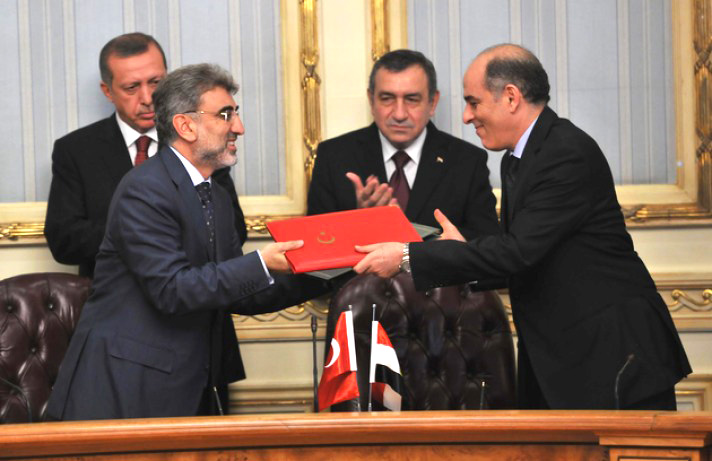
Egypt and Turkey entered into several new energy-sharing arrangements on a recent diplomatic visit to Cairo by Turkish Prime Minister Recep Tayyip Erdoğan and Energy Minister Taner Yıldız. Analysts speculate that the new alliance comes in response to a perceived Israeli-Cypriot alliance over natural gas extraction.

Oil wars are so last century. The resource with the potential to stir up most turmoil in the Mediterranean region over the next year? Natural gas. In the last week alone, the Turkish government has launched three aggressive foreign policy initiatives regarding this precious (and polluting) fuel.

It can be difficult to sift through all the news and figure out exactly what’s going on, and how each case is connected. Read on for a simple breakdown of natural gas politics in the Mediterranean — and how it’s unlikely to get simpler any time soon.

Read the rest of this entry >>

INTERVIEW: A Conversation With Nadire Mater

September 2011, TimeOut Istanbul (print edition only)

INTERVIEW: A Conversation With Nadire Mater

Nadire Mater is a founder and advisor of BIA, the Independent Communication Network, a ten-year-old project that brings together more than 130 newspapers and TV and radio stations to offer honest, locally based reporting on Turkey. Much of the content is available online at Bianet.org. Mater is also known for Mehmet’s Book, a collection of testimonies from Turkish soldiers who served in the southeast, which she published in 1999. In July, TimeOut sat down with Mater for a conversation about her work and her perspective on the current environment for freedom of expression in Turkey. 

In your last book, The Street is Beautiful, you wrote that “the street is the address of freedom.” Can you explain what you mean by this?

To start uprisings, to object, to be heard, to have a voice, you have to be in the street. You have to be there together with others who have the same demands, the same unrest. That’s why I believe the street is beautiful.

Continue reading “INTERVIEW: A Conversation With Nadire Mater”

New Report, Old News: Turkey’s Government Doesn’t Care About Limiting Greenhouse Gas Emissions

30 Aug., 2011, Green Prophet

Turkey’s greenhouse gas (GHG) emissions have increased by a whopping 98 percent in the last two decades, from 187 million tons of CO2 equivalent in 1990 to 370 million in 2009. That’s not as bad as India or China, where GHG emissions increased by 152 and 186 percent, respectively, in the same time period. But it’s a lot worse than the United States, where the increase was only 6 percent — or every country in the European Union, for that matter, where greenhouse gas emissions have all decreased since 1990.

What’s more, the Turkish government has resisted any binding solution to its skyrocketing GHG-emission rate. That, at least, is the conclusion of a new report by Bahçeşehir University Center for Economic and Social Research (BETAM) Research Fellow Barış Gençer Baykan.

Read the rest of this entry >>

REVIEW: Sifting Layers of Loyalty and Manufactured Reality in Turkey’s Tumultuous East

August 2011, TimeOut Istanbul (print edition only)

REVIEW: Rebel Land: Unraveling the Riddle of History in a Turkish Town, by Christopher de Bellaigue

As all good journalists and historians know, no source can be trusted at face value. They must be examined, any hidden agenda or bias taken into account, before their testimony can be considered.

Never is this principle more important than when studying recent conflicts. Academic sources about a dispute are rarely entirely academic; they are often the very weapons with which the dispute is still being fought. By trusting such sources, a scholar becomes implicated in the same conflict that he or she is trying to analyze from afar.

Such was the fate of Christopher de Bellaigue.

Continue reading “REVIEW: Sifting Layers of Loyalty and Manufactured Reality in Turkey’s Tumultuous East”

Hydrogen Energy: Not A Lost Cause As Far As Istanbul-Based UN Group Is Concerned

5 Aug., 2011, Reuters / SolveClimateNews

ISTANBUL, Turkey—At the end of June, Henry Puna, prime minister of the Cook Islands, a 90-square-mile archipelago in the South Pacific, traveled more than 11,000 miles on an unusual fact-finding mission to Turkey’s Bozcaada island in the Aegean Sea.

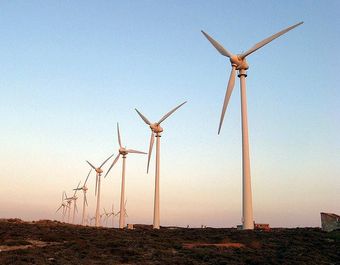
Puna came to see Bozcaada’s hospital and the house of its governor — two of the only buildings in the world partially powered by hydrogen-generated electricity. The unique prototype technology, which sounds like a back-to-the-future experiment, has been churning out zero-emissions power for the past few months.

Continue reading “Hydrogen Energy: Not A Lost Cause As Far As Istanbul-Based UN Group Is Concerned”